

.jpeg)

5 min
Introduction: The Real Cost of Document Intelligence
In sectors like finance, legal, and pharmaceuticals, document parsing isn’t just a technical task, it’s a compliance mandate. A single hallucination or a misread table in a 200-page regulatory filing can lead to multi-million dollar audit failures.
Modern documents have evolved beyond simple text, they are high-density hybrids of complex nested tables, technical diagrams, and non-standard layouts. While Generative AI (GenAI) has opened new doors, organizations face a critical strategic choice: do they build a custom solution using general-purpose cloud tools or invest in a specialized platform?
To help you navigate this decision, we will compare the traditional route of building with general-purpose cloud infrastructure against Lettria, a platform purpose-built for high-stakes document reasoning. We will examine how each approach stacks up in terms of accuracy, explainability, and total cost of ownership.
Option 1: Build with General-Purpose Cloud Tools
Most enterprises start by using the document intelligence toolkits provided by their existing cloud providers. These tools are designed as horizontal solutions to handle everything from receipts to basic tax forms.
The Pros
- Scalability: Leverage the global footprint and reliable uptime of major cloud providers.
- Stack Consistency: Keeps your data within your existing security and cloud environment.
The Cons
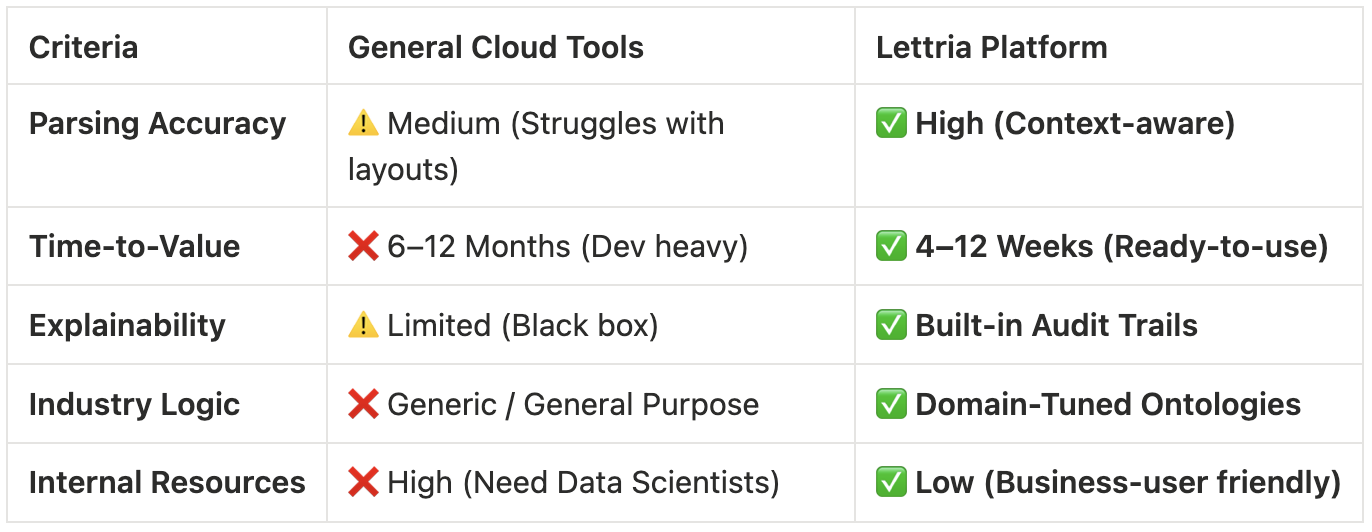
- The Shallow Parsing Gap: These tools often reach their limits with the high-density layouts common in clinical trials or legal contracts.
- High Engineering Overhead: You aren't buying a solution, you’re buying a toolkit. You will need a dedicated team of data scientists to build the RAG (Retrieval-Augmented Generation) layers and fix layout errors.
- The Black Box Problem: General models often lack the transparency required for deep regulatory audits.
Option 2: Buy Lettria’s Specialized Platform
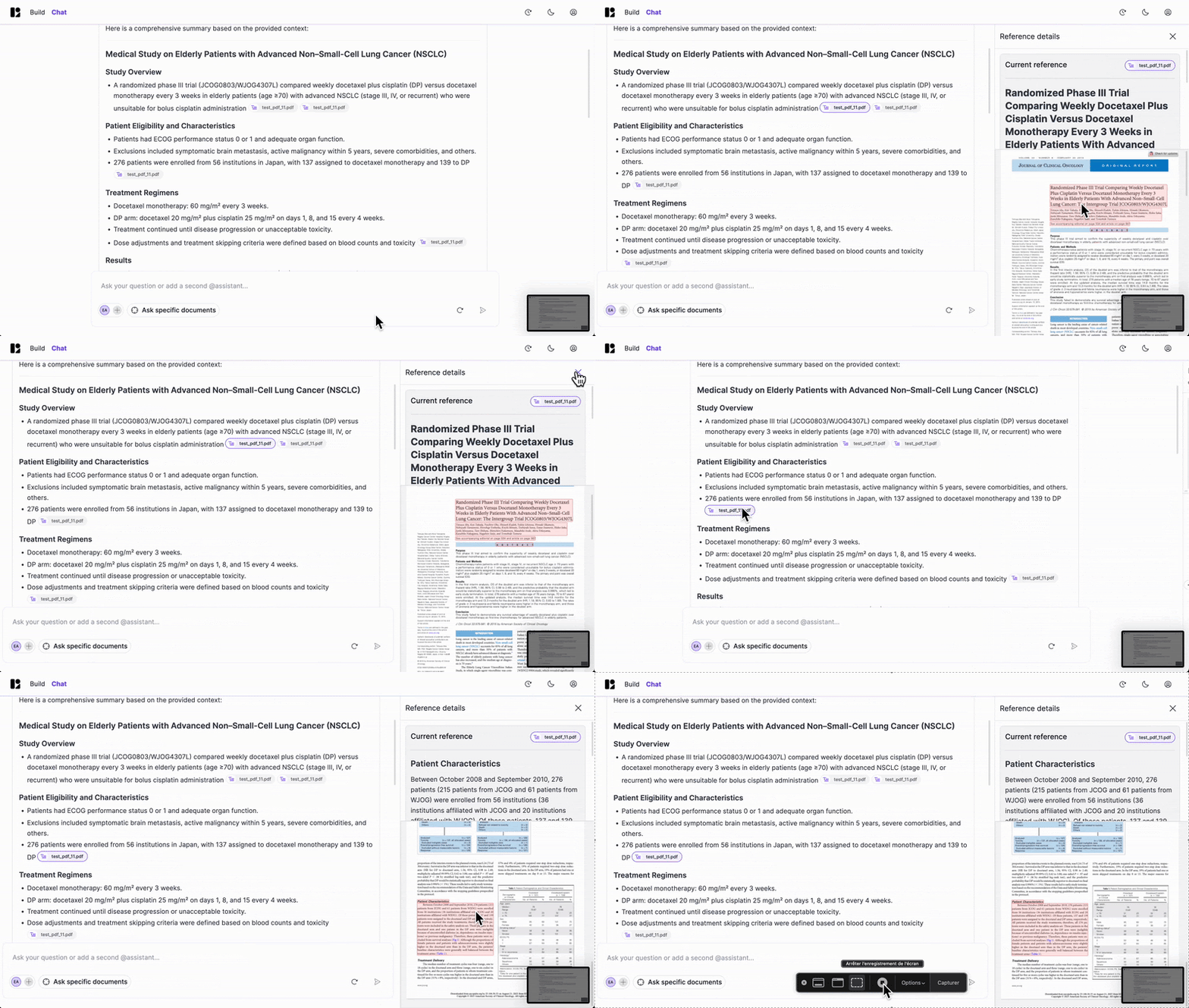
Lettria is a dedicated Intelligent Document Processing (IDP) platform built specifically for the nuances of complex industries.
The Pros
- Precision Parsing: Lettria uses a proprietary engine designed to understand the relationship between text, tables, and visual elements, rather than just reading words.
- GraphRAG Architecture: Unlike standard vector searches, Lettria uses GraphRAG, which connects data points through an ontology. This allows for structured reasoning and much higher accuracy.
- Explainability: Every output is traceable. For regulated industries, this audit trail is the difference between a pilot project and a production-ready tool.
- No-Code Interface: Business experts can refine the logic without waiting for a developer.
- 12-week Pilot Program: This structured onboarding ensures a path from ideation to production through three key phases:
- Weeks 1–4 (Connect Your Data): Defining project needs and parsing your specific unstructured data into a custom ontology.
- Weeks 5–8 (Activate Insights): Developing the first prototype and running feedback loops with an evaluation matrix.
- Weeks 9–12 (Monitor & Improve): Completing the final iteration and integrating with your existing systems via API.
Why General-Purpose Tools Often Struggle
General-purpose cloud tools are built for broad utility, which leads to specific technical hurdles when faced with complex regulatory documents.
- The Page Boundary Limitation: Major cloud tools fundamentally process documents on a per-page basis. They often fail to recognize data elements split across page boundaries, such as a table that starts on page 12 and ends on page 14.
- Ambiguous Reading Order: Standard engines typically read from top-to-bottom and left-to-right. In multi-column legal contracts or medical documents with sidebars, this logic fails, often jumbling the text and destroying its semantic meaning.
- Table and Layout Fragmentation: While many tools detect basic tables, they struggle with nested or borderless tables found in lab reports. This can lead to catastrophic data errors, such as assigning a drug dosage to the wrong patient ID.
- The Developer Gap: Because these are building-block technologies, your team must build custom routing and manual review queues to achieve production-level accuracy.
Key Evaluation Criteria
When to Build, When to Buy
Build with Cloud Toolkits if:
- You have a massive team of MLOps and Data Engineers ready for long-term development.
- Your document types are highly standardized and simple, like standard invoices.
- You require 100% custom-coded architecture from the ground up.
Buy Lettria if:
- You want speed, explainability, and industry-ready accuracy.
- You handle complex PDFs where close enough is a significant compliance risk.
- You need to explain why the AI reached a specific conclusion to a regulator.
Conclusion: What’s at Stake?
In the world of Document Intelligence, mistakes aren't just cosmetic, they are catastrophic. Relying on a general-purpose tool for a specialized industry is a high-risk gamble.
Before committing to a multi-year internal build that may never reach the required accuracy levels, evaluate a platform built for the task.
Don't leave your data to chance, join the Lettria Pilot Program.
Frequently Asked Questions
Yes. Lettria’s platform including Perseus is API-first, so we support over 50 native connectors and workflow automation tools (like Power Automate, web hooks etc,). We provide the speedy embedding of document intelligence into current compliance, audit, and risk management systems without disrupting existing processes or requiring extensive IT overhaul.
It dramatically reduces time spent on manual document parsing and risk identification by automating ontology building and semantic reasoning across large document sets. It can process an entire RFP answer in a few seconds, highlighting all compliant and non-compliant sections against one or multiple regulations, guidelines, or policies. This helps you quickly identify risks and ensure full compliance without manual review delays.
Lettria focuses on document intelligence for compliance, one of the hardest and most complex untapped challenges in the field. To tackle this, Lettria uses a unique graph-based text-to-graph generation model that is 30% more accurate and runs 400x faster than popular LLMs for parsing complex, multimodal compliance documents. It preserves document layout features like tables and diagrams as well as semantic relationships, enabling precise extraction and understanding of compliance content.


.jpeg)

.png)
.png)