.png)



.png)

4 min
UPDATE: Discover how Lettria’s Ontology Toolkit v2 outperforms handcrafted ontologies.
Creating a well-structured ontology is a powerful way to manage complex data, making it accessible, understandable, and usable. This guide covers the essentials of ontology development, walks you through the manual creation process, and explores the industries that benefit from it.
What is Ontology Development?
.jpg)
Ontology development is the process of creating a structured framework to define the relationships between different concepts within a particular domain. In essence, an ontology serves as a “map” of the data, enabling efficient knowledge management and retrieval.
Ontologies are valuable in any industry where structured data is essential for decision-making, from healthcare and finance to e-commerce and telecommunications. With a solid ontology, companies can organize data in ways that make it easier to navigate and leverage.
Why Ontology Development Matters
Ontology development enables:
- Enhanced Data Accessibility: Organizes data for easy access and understanding.
- Efficient Knowledge Management: Streamlines knowledge storage and retrieval.
- Better Decision-Making: Provides a clear structure for data-driven insights.
If your company handles large, interconnected datasets, ontology development is key to gaining actionable insights. Request a demo from Lettria to see how we can help streamline your data and improve your information flow.
Key Components of Ontology Development
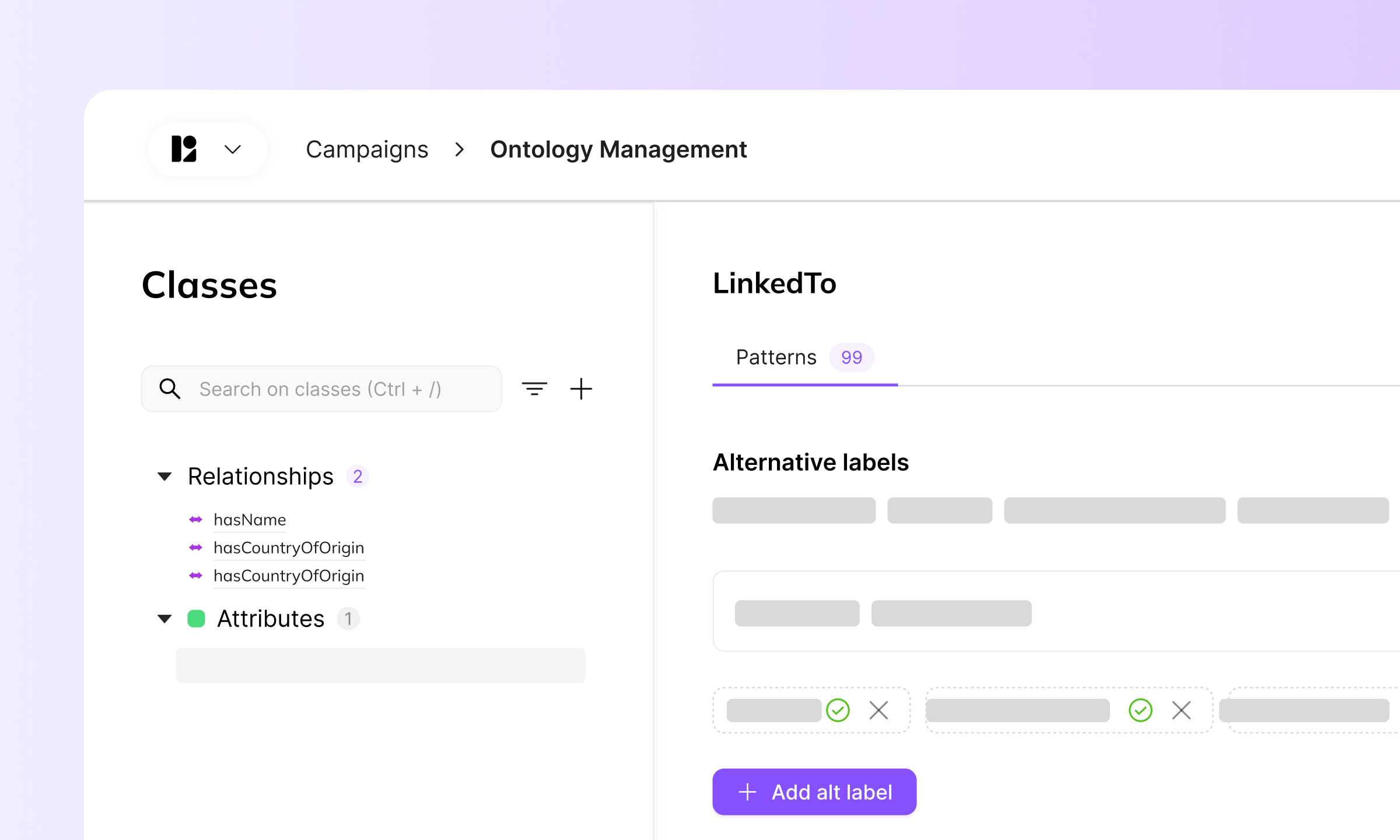
Before creating an ontology, it’s essential to understand the core components that shape this structure:
- Classes: These represent the categories or types of entities in the ontology (e.g., “Corporation” or “Contract”).
- Instances: These are specific examples within each class (e.g., “Acme Corp” is an instance of “Corporation”).
- Attributes (Data Properties): These define the literal values describing a class. For example, a “Contract” may have attributes like “Effective Date” (date) and “Value” (integer).
- Relationships (Object Properties): These illustrate how different classes and instances are connected. For example, a “Corporation” might “Sign” a “Contract.”
Step-by-Step Guide to Creating Your First Ontology
Creating an ontology can seem challenging, but breaking it down into manageable steps can simplify the process.
Important Note: There is no one correct way to model a domain, there are always viable alternatives. The best solution almost always depends on the application that you have in mind and the extensions that you anticipate.
To make this guide practical, we will follow a single enterprise example throughout these steps: Financial Compliance.
Step 1: Define the Domain, Scope, and Competency Questions
Start by identifying the domain (the specific area of knowledge) and the scope (the extent of detail). For our example, the domain is "Financial Compliance," and the scope covers corporate entities, shareholders, and risk assessments.
Crucially, you must define Competency Questions. These are the specific questions your ontology must be able to answer. This keeps your design focused on the application rather than trying to model the whole world.
- Example Question: “Who is the Ultimate Beneficial Owner (UBO) of Company X?”
- Example Question: “Does this customer have relationships with any sanctioned entities?”
Step 2: Research Existing Standards
Before building from scratch, check if a standard vocabulary already exists for your domain. In finance, for example, you might look at FIBO (Financial Industry Business Ontology). Reusing existing standards improves interoperability and saves time. If a standard meets some of your needs, you can import it and extend it rather than starting from zero.
Step 3: Identify Key Concepts (Classes)
Next, list the main concepts that need to be included. Think of these as the major “categories” that will shape your data structure.
- Compliance Example: Key classes would be LegalEntity, Person, Transaction, Jurisdiction, and SanctionList.
Step 4: Define Attributes and Relationships
Once you’ve established your classes, you need to provide detail. This is done through two types of properties:
1. Attributes (Data Properties)
These provide descriptive information about an entity (values like numbers, text, or dates).
- Example: The class Transaction has attributes like Amount (decimal), Currency (string), and Timestamp (date).
2. Relationships (Object Properties)
These show how one class interacts with another.
- Example: The class Person has a relationship isBeneficialOwnerOf connecting it to the class LegalEntity.
- Example: The class LegalEntity has a relationship isIncorporatedIn connecting it to the class Jurisdiction.
Clearly defining these connections is crucial as it enables the system to trace complex paths, such as finding hidden risks between a person and a company.
Step 5: Create a Hierarchical Structure
Organize your classes in a hierarchical structure, starting from broad categories and moving to more specific subcategories. This is known as taxonomy creation.
- Compliance Example:
- Agent (Parent Class)
- Person (Subclass)
- BoardMember (Subclass)
- Organization (Subclass)
- Corporation (Sub-subclass)
- Trust (Sub-subclass)
- Person (Subclass)
- Agent (Parent Class)
This structure allows for "inheritance." For example, if an "Agent" has a distinct "Risk Score," then both a "Person" and an "Organization" automatically inherit that attribute.
Step 6: Test, Validate, and Iterate
Testing your ontology is essential to ensure its accuracy and logic. This involves running your Competency Questions (from Step 1) to see if the ontology provides the right answers. You should also check for logical inconsistencies. For example, ensuring that a Corporation cannot have a Date of Birth.
Remember: Ontology development is necessarily an iterative process.
You will rarely get the model perfect on the first try. As you ingest real regulatory documents or as compliance rules change, you will need to revisit your classes and relationships. A well-maintained ontology evolves alongside your organization.
Industries Benefiting from Ontology Development
Ontology development offers significant advantages to a range of industries. Here are a few examples of how different sectors leverage ontologies to improve data management and decision-making.
1. Healthcare
Healthcare data is vast, interconnected, and complex. Ontologies help organize this data, making it easier to access and interpret.
Use Cases in Healthcare:
- Patient Records Management: Organize patient information, medical history, and treatment plans to support effective decision-making.
- Research and Drug Development: Create ontologies that connect clinical trials, drug effects, and patient demographics to enhance research outcomes.
2. Finance
Financial institutions manage massive amounts of data across transactions, customer profiles, and market trends. Ontologies help streamline this data for improved decision-making and risk management.
Use Cases in Finance:
- Fraud Detection: Identify patterns and relationships in transaction data to detect and prevent fraud.
- Customer Insights: Organize customer financial data, spending habits, and credit history to offer personalized financial products.
3. E-commerce
E-commerce businesses rely on structured data to understand customer behavior, product trends, and market demands. Ontologies help organize these data points to support personalized marketing and sales strategies.
Use Cases in E-commerce:
- Product Recommendations: Develop ontologies that link products, categories, and customer preferences to deliver tailored product suggestions.
- Inventory Management: Organize supplier information, product details, and stock levels to streamline supply chain management.
4. Telecommunications
The telecommunications industry deals with interconnected data on customer preferences, service usage, and network infrastructure. Ontologies support efficient customer service and network optimization.
Use Cases in Telecommunications:
- Customer Support: Organize customer issues, service history, and support tickets to provide more responsive service.
- Network Management: Develop ontologies that track infrastructure, maintenance records, and usage patterns to optimize network performance.
Examples of Ontology Development in Action
Let’s look at some practical examples of ontology development and how it drives results across various sectors.
Example 1: Healthcare - Enhanced Patient Care
A healthcare provider creates an ontology that connects patient records, treatment histories, and medical research data. This system enables doctors to access comprehensive patient profiles, aiding in more accurate diagnoses and personalized treatment plans.
Example 2: Finance - Streamlined Risk Assessment
A financial institution develops an ontology to organize customer financial data, market trends, and regulatory information. This structure supports more effective risk assessments and enables the institution to offer better financial advice based on each customer’s unique profile.
Example 3: E-commerce - Personalized Customer Journeys
An e-commerce company uses ontology development to link customer preferences, product categories, and shopping behaviors. The result is a robust recommendation engine that offers personalized product suggestions, enhancing customer engagement and sales.
Key Advantages of Lettria’s Ontology Development Platform
Lettria provides a unique approach to ontology development, offering powerful tools to streamline the process and deliver industry-specific solutions. Here’s how Lettria’s platform can support your business:
- User-Friendly Interface: Our platform makes it easy for users, regardless of technical background, to develop and manage ontologies.
- Customizable Solutions: Lettria allows for complete customization, ensuring that your ontology fits your business’s unique needs.
- Efficient Data Structuring: By focusing on relationships and context, our platform enables more accurate and insightful data management.
Want to see how Lettria can help you build an effective ontology? Request a demo today to explore our features and see how our platform can optimize your data management strategy.
Conclusion
Ontology development is a crucial step for businesses looking to structure complex data efficiently. By creating a clear framework for understanding and navigating data, ontologies drive better decision-making and improve information accessibility.
Lettria offers a comprehensive ontology development platform, allowing businesses across various industries to build, validate, and manage ontologies with ease. Interested in taking your data management to the next level? Contact Lettria for a demo to see how we can help you create a structured, scalable data framework tailored to your business needs.
Frequently Asked Questions
Yes. Lettria’s platform including Perseus is API-first, so we support over 50 native connectors and workflow automation tools (like Power Automate, web hooks etc,). We provide the speedy embedding of document intelligence into current compliance, audit, and risk management systems without disrupting existing processes or requiring extensive IT overhaul.
It dramatically reduces time spent on manual document parsing and risk identification by automating ontology building and semantic reasoning across large document sets. It can process an entire RFP answer in a few seconds, highlighting all compliant and non-compliant sections against one or multiple regulations, guidelines, or policies. This helps you quickly identify risks and ensure full compliance without manual review delays.
Lettria focuses on document intelligence for compliance, one of the hardest and most complex untapped challenges in the field. To tackle this, Lettria uses a unique graph-based text-to-graph generation model that is 30% more accurate and runs 400x faster than popular LLMs for parsing complex, multimodal compliance documents. It preserves document layout features like tables and diagrams as well as semantic relationships, enabling precise extraction and understanding of compliance content.