


.png)

8 min
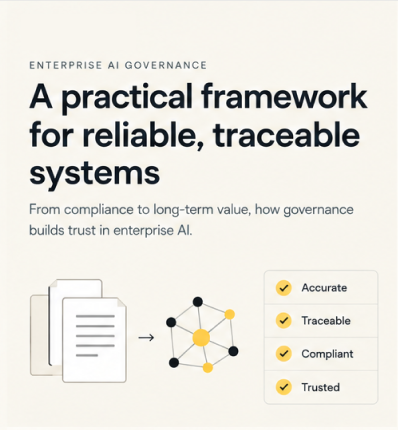
As artificial intelligence transitions from experimental sandboxes to production environments where real decisions happen, establishing a robust enterprise AI governance framework is no longer optional. Organizations must balance rapid innovation with stringent regulatory compliance, risk management, and data privacy requirements. At Lettria, we built our platform specifically for this challenge, providing transparent, verifiable AI infrastructure that transforms unstructured documents into traceable knowledge graphs. The result: enterprise AI deployments that remain both highly accurate and fully accountable.
Understanding enterprise AI governance in modern organizations
Why proactive AI oversight matters for reliable systems
Proactive AI oversight serves as the foundational mechanism that prevents algorithmic drift, mitigates systemic bias, and ensures that automated decisions strictly align with corporate ethics and legal standards. Without structured governance tools, organizations face compounding technical debt and severe reputational damage when model behavior deviates from intended parameters in live production environments.
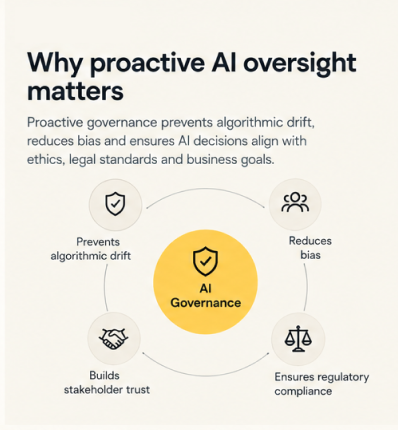
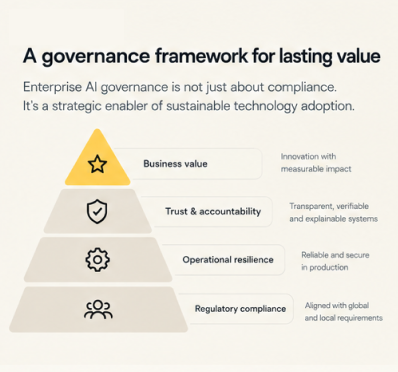
Frameworks like the NIST AI RMF address these critical vulnerabilities by embedding trustworthiness considerations across AI design and deployment. These systems remain valid, reliable, safe, and resilient under varying operational loads. By integrating these core principles early in the development lifecycle, enterprises can systematically quantify risks, establish precise baseline metrics for model performance, and foster enduring trust among stakeholders and end-users. This proactive stance transforms governance from a reactive compliance exercise into a strategic enabler of sustainable technology adoption.
Key regulatory drivers and compliance requirements
The global regulatory landscape for artificial intelligence is rapidly evolving, shifting from voluntary industry guidelines to strict, enforceable legal requirements that carry significant financial penalties. Federal mandates require completing an AI Impact Assessment before deploying high-impact use cases, ensuring that agencies and enterprises rigorously evaluate potential risks to civil rights, privacy, and public safety.
Beyond US federal directives, comprehensive regulations such as the EU AI Act impose tiered compliance obligations based entirely on the specific risk profile of the deployed technology. Organizations must implement standardized policies that govern data usage, algorithmic transparency, and overall accountability. Failure to meet these stringent compliance requirements can result in fines reaching up to 7% of global annual turnover and the forced decommissioning of non-compliant generative models, making regulatory alignment a critical business imperative.
Core pillars of an enterprise AI governance framework
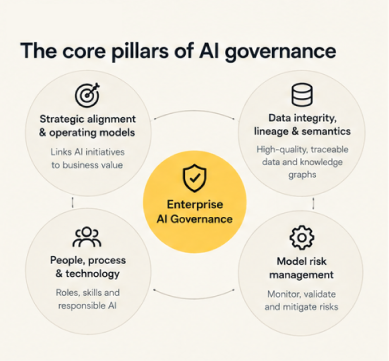
Strategic alignment and organizational operating models
A resilient operating model requires alignment between technical execution and executive oversight to ensure that AI initiatives deliver measurable business value. The GAO accountability framework's four core principles, governance, data, performance, and continuous monitoring, collectively ensure that AI adoption supports strategic business objectives while minimizing exposure to operational hazards.
Organizations should also reference ISO/IEC 42001 requirements for establishing and continually improving an organizational AI Management System. This international standard provides a highly structured approach to defining cross functional roles, allocating necessary resources, and integrating AI risk management directly into broader corporate governance structures, ensuring that accountability is maintained at the highest levels of leadership.
Data integrity, lineage, and semantic foundations
High data quality is the absolute bedrock of any reliable AI system, directly dictating the accuracy, safety, and explainability of model outputs. Joint CISA and NSA guidelines on securing data used to train and operate AI systems emphasize cryptographic verification, strict access controls, and comprehensive threat modeling.
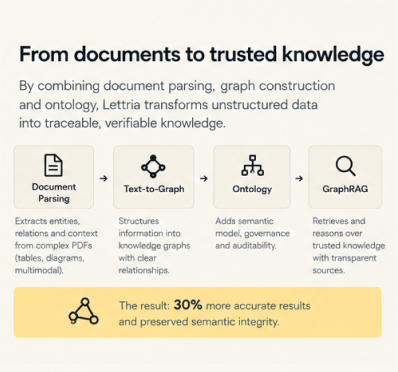
Here's the problem we see repeatedly: traditional vector-based retrieval often loses critical context, stripping away the relationships that give data its meaning. This is precisely why we built Lettria's GraphRAG and ontology building capabilities to preserve complex data relationships. By converting unstructured text into structured knowledge graphs via the Perseus system, enterprises achieve 30% more accurate results and maintain absolute semantic integrity across their data pipelines, ensuring that models are grounded in verifiable facts rather than probabilistic guesses.
Model risk management throughout the development lifecycle
Effective model risk management requires continuous, automated vigilance from initial data ingestion through to post-deployment monitoring. We strongly recommend implementing an AI-specific risk management plan to systematically identify, analyze, and mitigate risks across all operational phases and deployment environments.
To prevent cascading failures in production, engineering teams must emphasize iterative test, evaluation, validation, and verification (TEVV) processes during early AI lifecycle stages. These rigorous TEVV protocols ensure that models perform reliably under stress, that bias is quantified and minimized, and that any deviations in expected model behavior are immediately flagged before reaching end-users, thereby safeguarding the integrity of automated decisions. By embedding these risk management practices directly into the MLOps pipeline, organizations can reduce deployment times by up to 40% while maintaining strict adherence to internal safety thresholds and external regulatory demands.
Security, privacy, and continuous compliance monitoring
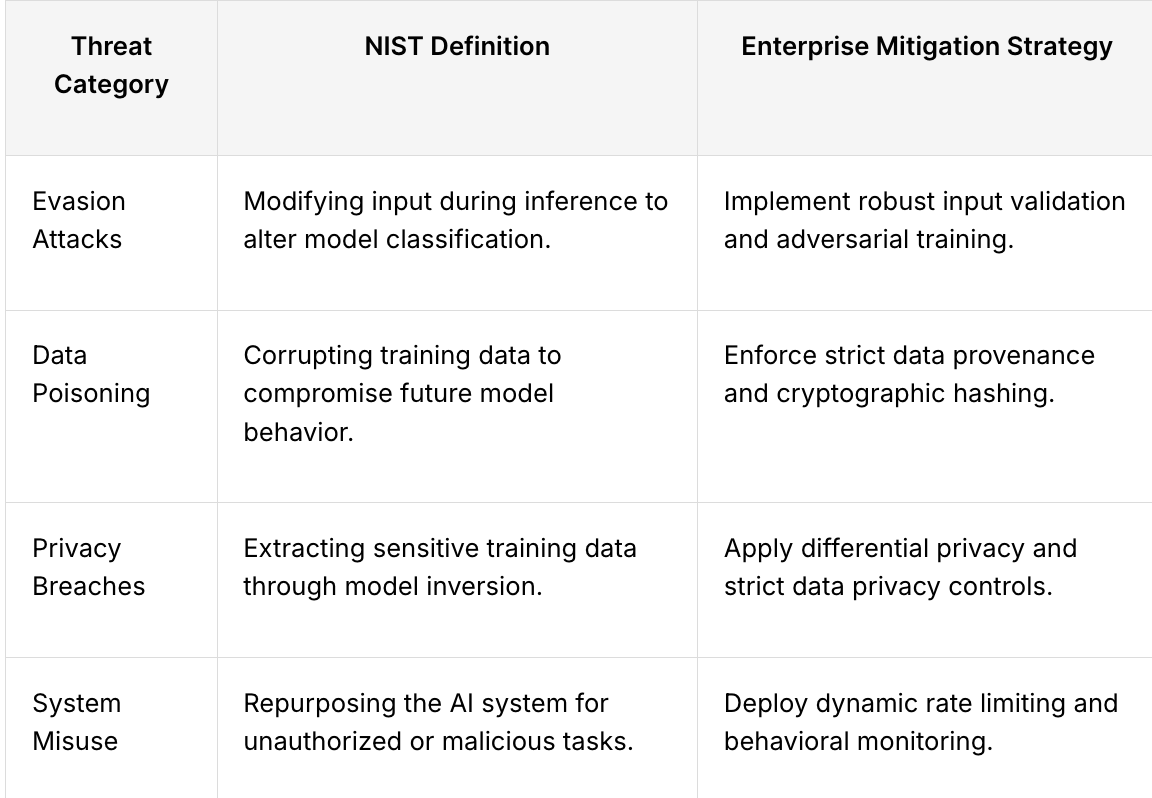
Securing enterprise AI infrastructure demands specialized technical controls that extend far beyond traditional cybersecurity measures. The adversarial machine learning risks categorized by NIST, including evasion, data poisoning, privacy, and misuse, specifically target the underlying logic of AI models. Continuous monitoring systems must be deployed to detect these sophisticated attack vectors in real-time, ensuring that data privacy is maintained and that models remain resilient against malicious exploitation.
Ensuring traceability and reliability in complex AI systems
Establishing transparent audit trails and data lineage
Traceability is a non-negotiable requirement for enterprise AI, enabling precise root-cause analysis when systems produce anomalous or unexpected outputs. Organizations must track provenance metadata covering creators, timestamps, modifications, data sources, and underlying generative datasets.
Maintaining these transparent audit trails ensures that every algorithmic decision can be traced back to its specific training data and configuration state. This granular documentation is vital for defending automated decisions during regulatory audits, maintaining the overall integrity of the enterprise architecture, and providing stakeholders with the mathematical proof required to trust complex model behavior in highly regulated industries. When something goes wrong, you need to know exactly why, not receive a vague probabilistic explanation.
Guardrails for generative and agentic AI applications
The deployment of autonomous and generative technologies introduces unprecedented unpredictability into enterprise workflows. To safely scale these advanced solutions, engineering teams must implement mitigation controls against adversarial threats across predictive, generative, and reinforcement learning modalities.
These programmatic guardrails act as real-time filters, preventing agentic systems from executing unauthorized actions, accessing restricted databases, or generating hallucinatory content. By enforcing strict boundary conditions and semantic validation checks, organizations can harness the transformative power of generative AI while strictly containing its operational blast radius and ensuring outputs remain factually grounded. The goal is simple: AI that answers with documented truth, not probable guesses.
Maintaining meaningful human oversight at scale
As AI systems process millions of transactions daily, maintaining meaningful human oversight requires strategic intervention rather than manual micromanagement. Enterprises must design workflows that incorporate human-in-the-loop (HITL) validation for high-stakes decisions, ensuring that human experts review edge cases and ambiguous outputs before final execution.
For lower-risk automated processes, human-on-the-loop (HOTL) monitoring allows operators to oversee system performance via aggregated dashboards and intervene only when statistical confidence thresholds drop below 95%. This tiered approach balances operational efficiency with the ethical imperative of human accountability, ensuring technology augments rather than replaces human judgment.
Step-by-step roadmap to implement enterprise AI governance
Inventory and classify AI assets and use cases
The first critical step in establishing control is achieving total visibility over the organization's entire AI footprint. Compliance frameworks mandate regular annual AI use-case inventories and public reporting aligned with federal governance standards to eliminate shadow AI.
Once inventoried, organizations must classify use cases by evaluating their potential impacts on privacy, civil rights, and access to services. This rigorous classification process dictates the level of scrutiny, the frequency of audits, and the specific governance tools required for each application, ensuring that resources are allocated efficiently based on actual risk exposure. Maintaining a centralized registry of all models, including their training data sources and intended operational parameters, provides a single source of truth for compliance officers and external auditors.
Define responsible AI policies and risk management tiers
Following comprehensive classification, enterprises must establish responsible AI policies that map directly to predefined risk management tiers. High-risk applications, such as those affecting employment or financial decisions, require stringent validation protocols, extensive bias testing, and mandatory executive sign-off before deployment. Conversely, minimal-risk internal productivity tools can operate under expedited, automated approval workflows.
This tiered structure ensures that governance efforts are proportionate to the actual risk, preventing bureaucratic bottlenecks while safeguarding critical business functions and ensuring that ethical guidelines are consistently applied across all development teams. Establishing clear thresholds for acceptable error rates and defining specific remediation procedures for when models underperform are essential components of these tiered policies.
Deploy centralized technical controls and monitoring systems
Policy documentation alone is insufficient without robust technical enforcement mechanisms embedded within the infrastructure. Enterprises must deploy centralized technical controls that automatically enforce governance standards across the entire model lifecycle.
Key technical implementations include:
- API gateways to manage and log all model inference requests.
- Automated bias detection algorithms integrated into CI/CD pipelines.
- Real-time performance monitoring dashboards that track statistical drift and accuracy metrics.
By embedding these controls directly into the MLOps pipeline, organizations can programmatically halt the deployment of models that fail to meet established data quality or ethical thresholds, ensuring that only fully compliant systems reach the production environment.
Foster cross-functional accountability and continuous improvement
Sustainable AI governance requires a fundamental cultural shift that breaks down traditional silos between data science, legal, and business units. Organizations should apply ISO/IEC 42001 principles to maintain organizational policies and achieve responsible AI deployment objectives through structured cross functional collaboration.
Establishing an AI ethics board comprising diverse stakeholders ensures that multiple perspectives inform algorithmic guidelines and risk assessments. Through regular audits, incident reporting, and iterative feedback loops, this collaborative approach drives continuous improvement, allowing the governance framework to adapt dynamically to emerging technological capabilities and shifting regulatory landscapes.
Conclusion: scaling enterprise AI with confidence and control
Implementing a comprehensive enterprise AI governance framework is essential for transforming experimental models into reliable, production-ready assets. By prioritizing data lineage, continuous monitoring, and strict regulatory alignment, organizations can confidently scale their AI initiatives while mitigating critical risks.
The foundation of this trust lies in verifiable data structures and transparent architectures. This is exactly why we built Lettria: to provide the Perseus text-to-graph AI system and Python SDK that construct highly structured, traceable knowledge graphs integrating with graph databases like Neo4j. This semantic approach guarantees that your AI applications remain accurate, explainable, and fully compliant with emerging regulations. Alongside each answer, you see the graphs, nodes, and snippets that led the machine to its final output.
Ready to see how ontology-driven architecture can secure your AI deployments? Book a demo today.
Frequently asked questions
What is enterprise AI governance?
Enterprise AI governance is a comprehensive, strategic framework of policies, technical controls, and cross functional processes designed to ensure that artificial intelligence systems operate securely, ethically, and in strict compliance with evolving regulatory standards. It provides the essential organizational structure required to systematically manage model risk, enforce rigorous data privacy protocols, and maintain meaningful human oversight across the entire machine learning lifecycle, from initial data ingestion to post-deployment monitoring, thereby protecting the enterprise from legal liabilities.
What is the 30% rule in AI governance?
In the context of advanced semantic architectures and knowledge graphs, the 30% rule refers to the proven benchmark where systems preserving complex data relationships deliver 30% more accurate results compared to traditional vector-based retrieval methods. This quantifiable threshold highlights the critical importance of data quality and structural integrity in mitigating algorithmic hallucinations, ensuring reliable model behavior, and meeting the stringent accuracy requirements demanded by enterprise-grade governance frameworks in highly regulated industries like finance and healthcare.
What are practical examples of AI governance frameworks?
Industry professionals, legal experts, and regulatory bodies consistently cite the NIST AI RMF and ISO/IEC 42001 standard as established organizational governance benchmarks that provide highly actionable, evidence-based guidelines for comprehensive risk management and system trustworthiness. These internationally recognized frameworks offer standardized, scalable methodologies for implementing transparent audit trails, conducting rigorous algorithmic impact assessments, and maintaining continuous compliance monitoring across diverse, highly regulated enterprise environments, ensuring that AI adoption aligns with global legal mandates.
How does governance differ for autonomous AI agents?
Governance for autonomous agentic AI requires dynamic, real-time guardrails that strictly limit the system's execution environment and programmatically prevent unauthorized actions or database modifications without explicit human validation. Unlike static predictive models, autonomous agents demand continuous behavioral monitoring, strict API access controls, and hardcoded boundary conditions to effectively contain their operational blast radius, prevent cascading system failures, and mitigate sophisticated adversarial threats in live production environments, ensuring that automated workflows remain secure and predictable.
Frequently Asked Questions
Yes. Lettria’s platform including Perseus is API-first, so we support over 50 native connectors and workflow automation tools (like Power Automate, web hooks etc,). We provide the speedy embedding of document intelligence into current compliance, audit, and risk management systems without disrupting existing processes or requiring extensive IT overhaul.
It dramatically reduces time spent on manual document parsing and risk identification by automating ontology building and semantic reasoning across large document sets. It can process an entire RFP answer in a few seconds, highlighting all compliant and non-compliant sections against one or multiple regulations, guidelines, or policies. This helps you quickly identify risks and ensure full compliance without manual review delays.
Lettria focuses on document intelligence for compliance, one of the hardest and most complex untapped challenges in the field. To tackle this, Lettria uses a unique graph-based text-to-graph generation model that is 30% more accurate and runs 400x faster than popular LLMs for parsing complex, multimodal compliance documents. It preserves document layout features like tables and diagrams as well as semantic relationships, enabling precise extraction and understanding of compliance content.