.png)



.png)

6 min
The integration of ai agents in finance is moving from experimental pilots to core operational infrastructure, with financial institutions betting on efficiency gains across complex data environments. But here's the reality: traditional language models struggle with the strict accuracy and auditability requirements that finance demands. Standard retrieval methods simply aren't enough. At Lettria, we address this gap by structuring complex financial documents into enterprise knowledge graphs, providing the exact context these agents need to deliver reliable, traceable insights.
Key takeaways about AI agents in finance
.png)
- AI agents in finance are autonomous systems that adapt dynamically to new information, but only 13.5% of finance organizations currently deploy them due to accuracy and auditability concerns.
- These agents can reduce invoice processing times by up to 60% and have already helped recover $1 billion in fraud detection, demonstrating measurable ROI across financial workflows.
- Enterprise knowledge graphs deliver 30% more accurate results than traditional vector search by preserving critical data relationships and providing full traceability for regulatory compliance.
- Success depends on moving beyond black-box models toward transparent, graph-based architectures that structure complex documents into actionable knowledge with complete audit trails.
What are AI agents in finance?
AI agents in finance are autonomous software systems powered by artificial intelligence that perceive their environment, make decisions, and execute actions to achieve specific financial objectives. Unlike manual scripts that follow rigid paths, agentic AI dynamically adapts to new information, reasons through multi-step workflows, and interacts with various enterprise applications. Yet despite their potential to transform operations, adoption remains cautious. A Deloitte survey shows only 13.5% of finance organizations currently deploy agentic AI within their operating model.
This hesitation makes sense when you consider the stakes. The critical need for accuracy and the risk of hallucinations in standard language models keep finance leaders appropriately wary. For finance teams, an advanced agent must do more than process vast amounts of unstructured data. It must understand the intricate relationships between entities: corporate hierarchies, regulatory frameworks, transaction histories. When properly grounded in structured knowledge, these agents transition from simple chatbots to sophisticated digital workers capable of executing tasks with the precision financial services require.
Strategic use cases transforming financial workflows
Financial institutions deploy AI across a broad spectrum of operations, including credit underwriting, trading, compliance, and process automation. The result is a fundamental reshaping of how finance teams manage risk and efficiency.
Accounts payable and invoice reconciliation
Manual invoice processing and accounts payable workflows are highly susceptible to human error and operational bottlenecks. AI agents address this by autonomously extracting line-item data, cross-referencing purchase orders, and executing three-way matching protocols. With intelligent agents handling these tasks, a company can reduce invoice processing times by up to 60%, minimizing late fees, optimizing spend management, and improving overall accounting efficiency.
Real-time fraud detection and risk monitoring
The financial impact of sophisticated fraud demands systems capable of analyzing transaction patterns in real time. Consider this: Treasury's payment integrity office recovered $1 billion using machine learning fraud detection, demonstrating the massive ROI of these technologies. Agents continuously monitor data against historical baselines and complex risk typologies, flagging anomalies that traditional rule-based systems miss. This protects institutional assets and supports robust policy enforcement.
Financial forecasting and variance analysis
Strategic planning relies heavily on accurate predictive models to guide business strategy. Financial institutions utilize AI to strengthen forecasting accuracy and improve stress testing by analyzing macroeconomic indicators alongside internal performance metrics. AI agents can autonomously run thousands of Monte Carlo simulations, adjusting variables to provide finance leaders with probabilistic outcomes. This data-driven approach to variance analysis allows units to pivot rapidly in response to market volatility.
Why context and structured knowledge are critical for financial AI agents
For ai agents in finance to function reliably, they require deep contextual understanding that standard databases often fail to provide. Structured knowledge architectures become essential for meaningful support.
Moving beyond vector search with enterprise knowledge graphs
.png)
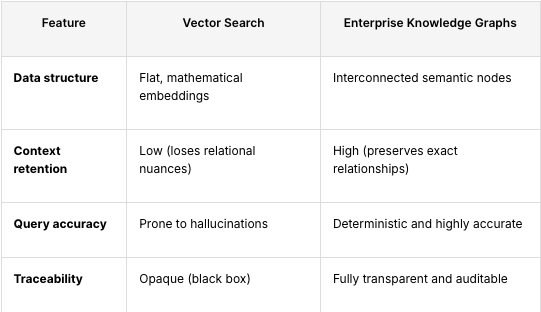
Traditional vector-based systems frequently lose critical context when processing complex financial documents. The result? Disjointed insights that can't support high-stakes decisions. Enterprise knowledge graphs solve this by mapping explicit relationships between entities. Using a text-to-graph AI system like Lettria's Perseus allows organizations to build these ontologies efficiently, delivering up to 30% more accurate results than standard vector search.
The key differences impacting model performance include:
Ensuring auditability and traceable decision-making
Regulatory compliance mandates that every automated financial decision be fully explainable. Financial institutions implement audit trails and continuous output monitoring for model transparency, allowing AI-driven actions to be reviewed by human auditors. Organizations should also reference the NIST Generative AI Profile for integrating trustworthiness considerations into financial AI governance frameworks.
Essential governance components include:
- Immutable logging of all agent decisions and actions
- Node-level traceability for every generated report
- Continuous alignment with internal policy and external regulations
.png)
Conclusion: the future of context-aware financial AI agents
The deployment of ai agents in finance represents a fundamental shift from manual data processing to autonomous, intelligent operations. However, the success of these initiatives hinges entirely on the quality and structure of the underlying data. As financial services continue to scale their AI strategy, moving away from black-box models toward transparent, graph-based architectures will be the defining factor in achieving reliable automation.
For organizations looking to bridge the gap between AI promises and enterprise reality, implementing a robust text-to-graph platform like Lettria provides the necessary foundation. By structuring complex documents into actionable knowledge graphs, finance teams can confidently deploy solutions that deliver precise, auditable, and context-aware results.
Frequently asked questions
Understanding the practical applications and governance of ai agents in finance is crucial for finance professionals navigating this technological transition.
What can AI agents do in finance?
AI agents can autonomously execute complex, multi-step workflows such as reconciling accounts payable, monitoring real time transaction data for fraud, and generating dynamic financial forecasts. They act as intelligent digital workers that analyze vast datasets to support strategic business decisions and simplify compliance reporting.
What is the 30% rule for AI?
In the context of enterprise AI implementation, the 30% rule often refers to the benchmark improvement in accuracy and efficiency when upgrading from basic models to context-aware systems. For instance, utilizing structured knowledge graphs instead of traditional vector search can yield 30% more accurate results by preserving critical data relationships.
How do AI agents differ from traditional financial automation?
Traditional financial automation relies on rigid, rule-based scripts that break when encountering exceptions or unstructured data formats. In contrast, an advanced agent uses artificial intelligence to reason through ambiguities, adapt to new information, and independently determine the best sequence of actions to achieve a specific goal.
How do finance teams maintain control over autonomous AI agents?
Organizations maintain control by implementing strict governance frameworks, continuous output monitoring, and human-in-the-loop validation protocols. A telling statistic: 59.7% of surveyed finance professionals trust AI agents only within defined frameworks. This emphasizes the need for traceable decision-making and robust audit trails to meet regulatory compliance requirements.
Frequently Asked Questions
Yes. Lettria’s platform including Perseus is API-first, so we support over 50 native connectors and workflow automation tools (like Power Automate, web hooks etc,). We provide the speedy embedding of document intelligence into current compliance, audit, and risk management systems without disrupting existing processes or requiring extensive IT overhaul.
It dramatically reduces time spent on manual document parsing and risk identification by automating ontology building and semantic reasoning across large document sets. It can process an entire RFP answer in a few seconds, highlighting all compliant and non-compliant sections against one or multiple regulations, guidelines, or policies. This helps you quickly identify risks and ensure full compliance without manual review delays.
Lettria focuses on document intelligence for compliance, one of the hardest and most complex untapped challenges in the field. To tackle this, Lettria uses a unique graph-based text-to-graph generation model that is 30% more accurate and runs 400x faster than popular LLMs for parsing complex, multimodal compliance documents. It preserves document layout features like tables and diagrams as well as semantic relationships, enabling precise extraction and understanding of compliance content.


.png)
.jpeg)
.jpeg)