.png)



.png)

6 min
The transition from experimental artificial intelligence to production-grade enterprise AI remains a real challenge for modern organizations. While generative models offer impressive capabilities, they often lack the traceability and contextual accuracy required for mission-critical business operations. At Lettria, we tackle this head-on by using knowledge graphs and GraphRAG technology to transform unstructured documents into verifiable, structured data. This approach means enterprise machine intelligence delivers reliable, compliant, and actionable insights at scale.
Key takeaways on enterprise AI implementation
- Knowledge graphs deliver 30% more accurate AI results than vector-based systems by preserving data relationships and context that traditional RAG systems lose during document processing.
- GraphRAG technology provides full traceability from source documents to AI outputs, meeting compliance requirements through deterministic reasoning paths that auditors can verify.
- Enterprise AI adoption remains concentrated among large organizations, with only 18% of firms implementing AI at scale due to challenges in moving from experimental pilots to production-ready systems.
- Structured knowledge representation reduces operational risk and improves execution speed by up to 60% compared to probabilistic text generation approaches.
The enterprise AI challenge: moving from promising pilots to production-ready solutions
Despite massive investments, implementing enterprise ai at scale presents substantial operational bottlenecks. According to the Federal Reserve, about 18 percent of firms had adopted AI as of year-end 2025, with the largest firms maintaining the highest AI adoption rates across surveyed organizations. This concentration among industry leaders highlights the resource-intensive nature of moving from isolated pilots to enterprise-wide deployment. The momentum is undeniable; a Government Accountability Office (GAO) report noted that reported AI use cases grew from 571 to 1,110 across 11 reviewed agencies between 2023 and 2024.
However, scaling these initiatives requires moving beyond basic prompt engineering to establishing robust data governance and security frameworks. Organizations struggle with model context limitations and the risk of hallucinations when relying solely on vector databases. To achieve true enterprise artificial intelligence, companies must bridge the gap between unstructured data silos and the strict compliance requirements of corporate AI environments. This necessitates a shift toward more structured, deterministic architectures.
Why knowledge graphs deliver reliable enterprise AI systems
Transitioning to reliable AI for enterprise requires foundational technologies that prioritize accuracy and traceability over mere probabilistic text generation.
Building trustworthy AI with structured data relationships and semantic understanding
.png)
Traditional vector-based Retrieval-Augmented Generation (RAG) systems often fragment information, leading to a loss of critical context during retrieval. By contrast, knowledge graphs map explicit relationships between entities, creating a semantic data model that machines can navigate deterministically. This structured approach to enterprise ai solutions preserves the nuanced connections within complex documents. For instance, utilizing text-to-graph conversion systems can yield up to 30% more accurate results compared to standard vector search alone. By anchoring the model context in verified organizational data, businesses mitigate hallucination risks and make sure the AI agent operates within strictly defined operational boundaries. This level of precision is a core component of any successful enterprise ai strategy.
Creating transparent AI reasoning that meets compliance and audit requirements
.png)
In highly regulated sectors, the "black box" nature of standard large language models presents unacceptable compliance risks. Knowledge graphs solve this by providing a fully traceable path from the source document to the final output. Every node and edge within the graph serves as an auditable record of how the enterprise ai arrived at a specific conclusion. This transparent architecture allows compliance teams to implement precise access control and policy enforcement mechanisms.
Key governance benefits include:
- Granular identity and access management for sensitive nodes.
- Automated logging of all retrieval paths for audit approval.
- Protection against prompt injection and adversarial inputs through strict semantic boundaries.
When an automated workflow generates a financial or clinical insight, auditors can instantly verify the exact data lineage. The system adheres to strict governance rules and regulatory thresholds, no guesswork involved.
Building a robust enterprise AI architecture
A scalable enterprise ai strategy demands an architecture that integrates structured knowledge representation with automated execution capabilities.
Connecting semantic knowledge models with intelligent workflow automation
Effective enterprise machine intelligence relies on translating unstructured text into machine-readable formats that power automated workflows. This requires a unified API and robust SDKs to bridge the gap between raw data and intelligent agents. We built Perseus specifically for this purpose, converting complex documents into structured knowledge graphs while automatically generating the necessary entities and relations through our ontology generation capabilities. By integrating these semantic models directly into the business logic, organizations can trigger automated actions based on precise data conditions. This integration means that when an AI agent executes a task, it relies on a deterministic framework rather than probabilistic guessing, reducing operational risk and improving execution speed by up to 60%.
Deploying GraphRAG technology across complex organizational processes
.png)
GraphRAG represents the next evolution in enterprise-grade ai, combining the generative power of LLMs with the factual grounding of graph databases. Deploying this technology requires storing the generated graph structures in specialized databases like Neo4j or FalkorDB.
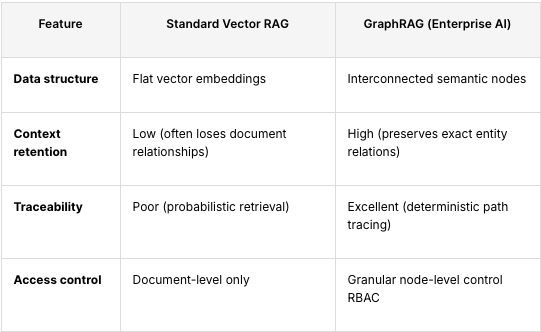
By querying these interconnected databases, GraphRAG systems can traverse complex relationships that standard vector searches miss. This capability is critical for enterprise-wide deployments where cross-departmental data integration is necessary. Sensitive information remains secure while authorized users get the comprehensive context they need.
Conclusion: transforming enterprise intelligence with proven AI foundations
The future of enterprise ai lies in moving beyond experimental generative models toward structured, verifiable systems. As organizations scale their AI initiatives, the limitations of standard vector search become apparent. The need for semantic understanding and data traceability becomes impossible to ignore.
By using knowledge graphs and GraphRAG technology, businesses can build trustworthy enterprise ai solutions that meet stringent compliance and security standards. We built Lettria precisely because achieving this level of reliability requires specialized tools designed for complex data environments. Our infrastructure handles document parsing, ontology building, and deployment of graph-based AI agents that actually work in production. Anchoring artificial intelligence for enterprise in structured knowledge is the most reliable path to actionable, accurate, and secure business intelligence.
Frequently asked questions
What is the difference between generative AI and enterprise AI?
Generative AI focuses on creating new content based on probabilistic patterns, whereas enterprise ai applies these technologies within strict operational, security, and governance guardrails to solve specific business problems. Highlighting this shift toward business application, a GAO report noted that generative AI use cases jumped nine-fold from 32 to 282 between 2023 and 2024 across reviewed agencies.
What does enterprise AI cost?
The cost of implementing enterprise ai varies widely, from $50,000 for targeted departmental solutions to over $1 million for comprehensive, enterprise-wide deployments involving custom model training and integration. These expenses typically encompass infrastructure, API usage, data management, and ongoing FinOps monitoring to maintain sustainable ROI and operational efficiency.
Why are knowledge graphs better than vector search alone for enterprise use cases?
Knowledge graphs explicitly map the relationships between data entities, preserving critical context that vector search often loses when chunking documents into isolated embeddings. This semantic structure allows GraphRAG systems to deliver highly accurate, traceable answers required for compliance and safety in corporate AI environments.
How do enterprises ensure data security and governance in AI deployments?
Organizations enforce security through strict access control, role-based permissions (RBAC), rate limiting, and continuous logging of AI agent actions to maintain compliance. However, aligning these systems with legacy rules remains challenging. Officials at 10 of 12 agencies cited existing data privacy policies as adoption obstacles in a recent GAO report. Building proper governance frameworks from the start helps organizations avoid these roadblocks.
Frequently Asked Questions
Yes. Lettria’s platform including Perseus is API-first, so we support over 50 native connectors and workflow automation tools (like Power Automate, web hooks etc,). We provide the speedy embedding of document intelligence into current compliance, audit, and risk management systems without disrupting existing processes or requiring extensive IT overhaul.
It dramatically reduces time spent on manual document parsing and risk identification by automating ontology building and semantic reasoning across large document sets. It can process an entire RFP answer in a few seconds, highlighting all compliant and non-compliant sections against one or multiple regulations, guidelines, or policies. This helps you quickly identify risks and ensure full compliance without manual review delays.
Lettria focuses on document intelligence for compliance, one of the hardest and most complex untapped challenges in the field. To tackle this, Lettria uses a unique graph-based text-to-graph generation model that is 30% more accurate and runs 400x faster than popular LLMs for parsing complex, multimodal compliance documents. It preserves document layout features like tables and diagrams as well as semantic relationships, enabling precise extraction and understanding of compliance content.


.png)
.png)
.png)