


.png)

10 min
As organizations scale their artificial intelligence initiatives, the architectural choices behind enterprise AI solutions dictate their ultimate success, reliability, and security. The current technical landscape is defined by a critical divergence in data retrieval methodologies: relying on probabilistic vector search versus deterministic knowledge graphs. At Lettria, we've built the infrastructure to bridge this gap, transforming complex corporate data into verifiable, graph-based systems that actually work in production. Understanding how to apply these technologies is essential for building AI that delivers measurable business value rather than just impressive demos.
%201.png)
Understanding enterprise AI solutions
Enterprise AI solutions represent a fundamental shift from experimental machine learning models to production-grade, scalable systems integrated directly into core business operations.
What defines enterprise AI?
Enterprise AI solutions are distinguished by their strict adherence to corporate governance, scalability requirements, and data security protocols rather than just their algorithmic complexity. Unlike consumer-grade applications, a custom enterprise platform must support high-throughput environments, often processing upwards of 10,000 queries per minute while maintaining 99.9% uptime service level agreements (SLAs). These systems require robust role-based access control (RBAC), end-to-end encryption, and the ability to integrate with legacy data sources across hybrid cloud architectures. Furthermore, enterprise artificial intelligence solutions demand strict auditability, ensuring that every output generated by foundation models can be traced back to specific, authorized internal documents to prevent compliance violations.
The evolution of AI in business
The trajectory of business AI solutions has accelerated rapidly, transitioning from isolated predictive analytics to comprehensive generative ecosystems. This massive shift is reflected in capital allocation; corporate AI investment reached $252.3 billion in 2024, driven heavily by private investment growth (Stanford AI Index Report). Early iterations of enterprise machine learning solutions focused primarily on structured data tasks like churn prediction or inventory forecasting, which typically yielded incremental efficiency gains of 5% to 8%. Today, the integration of large language models (LLMs) and natural language processing capabilities allows companies to deploy sophisticated agents capable of reasoning over unstructured content. This evolution has transformed AI from a specialized IT function into an enterprise-wide strategic imperative, fundamentally altering how organizations manage knowledge and execute complex workflows.
Why enterprises are adopting AI: Key benefits and drivers
Organizational AI adoption climbed to 78% in 2024, with generative AI use reaching 71% (Stanford AI Index Report), as companies seek to maintain competitive advantages through advanced technology.
Enhancing operational efficiency and automation
The primary driver for deploying enterprise AI solutions is the automation of repetitive, high-volume tasks to optimize resource allocation. However, the financial impact varies significantly based on implementation maturity; notably, 49% of enterprises using AI in service operations achieve cost savings under 10% (Stanford AI Index Report). To push beyond this baseline, organizations are moving away from basic robotic process automation (RPA) toward intelligent automation powered by custom models. By integrating AI into supply chain logistics or document processing pipelines, companies can reduce manual data entry errors by up to 85% and accelerate processing times from days to mere seconds. This level of operational efficiency requires tightly managed workflows where AI agents execute specific tasks within predefined confidence thresholds, typically requiring human-in-the-loop intervention only when model certainty drops below 80%.
Driving data-driven decision-making
Modern enterprise intelligence solutions transform fragmented data silos into unified, queryable assets that empower executive teams. By applying advanced machine learning algorithms, organizations can analyze historical datasets containing millions of rows in under 500 milliseconds to identify hidden market trends. This capability reduces the average time-to-insight for business intelligence teams by approximately 60%, allowing for real-time strategic adjustments. Furthermore, predictive analytics models allow companies to forecast demand fluctuations with 92% accuracy, significantly outperforming traditional statistical methods. When decision-makers have immediate access to synthesized, cross-departmental data, they can mitigate risks proactively and allocate capital more effectively across the organization.
Improving customer and employee experiences
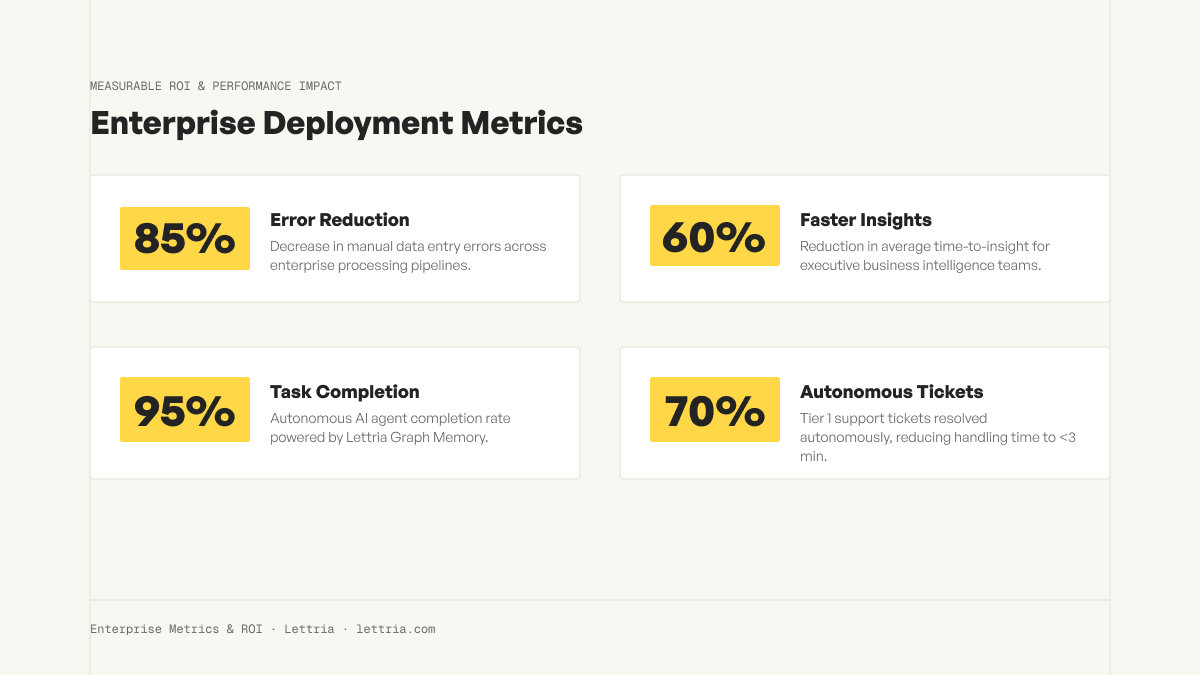
Implementing enterprise AI solutions directly impacts both external customer satisfaction and internal employee productivity. On the customer front, AI-driven support systems utilizing natural language understanding can resolve up to 70% of Tier 1 support tickets autonomously, reducing average handling times from 12 minutes to under 3 minutes. Internally, AI assistants act as force multipliers for employees, particularly in software development and content creation. Developers utilizing AI code generation tools report a 35% increase in deployment velocity, while HR and onboarding teams use conversational interfaces to reduce policy retrieval times by 80%. By removing friction from daily tasks, these tools significantly improve the overall employee experience and allow human talent to focus on high-value, strategic initiatives.
Core components of advanced enterprise AI: Knowledge graphs and vector search
The architecture of modern enterprise AI relies heavily on how data is structured and retrieved, primarily utilizing either semantic graphs or high-dimensional vectors.
Knowledge graphs: Structuring interconnected data for context
Knowledge graphs represent data deterministically by mapping entities and their relationships through semantic triples (subject-predicate-object), creating a highly structured, machine-readable web of context. This architecture is crucial for industries requiring absolute precision, as it allows systems to traverse billions of interconnected nodes to retrieve exact factual relationships with 100% deterministic accuracy. Building these structures manually is notoriously resource-intensive, often taking data engineering teams 6 to 12 months to model a single domain. To accelerate this process, organizations utilize Lettria's automated ontology generation tools for structuring complex corporate data into actionable knowledge graphs. By automating the extraction of entities and relations from unstructured text, enterprises can deploy robust data models in weeks rather than months, ensuring that their AI applications are grounded in verified, domain-specific logic.
Vector search: Leveraging semantic similarity for retrieval
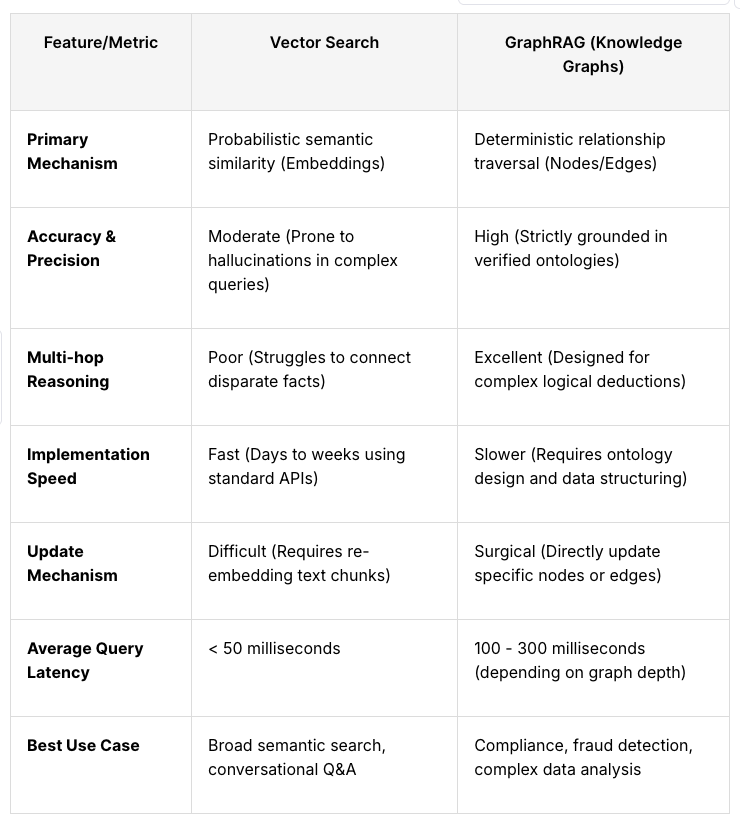
Vector search operates by converting text, images, or code into high-dimensional numerical representations called embeddings, typically ranging from 384 to 1,536 dimensions depending on the foundation models used. These embeddings are stored in specialized vector databases where algorithms like Hierarchical Navigable Small World (HNSW) calculate the cosine similarity between a user's query and the stored data. This probabilistic approach excels at finding conceptually similar information even when exact keywords are absent, processing queries across millions of documents in under 50 milliseconds. While highly scalable and relatively simple to deploy using platforms like Google Cloud or OpenAI APIs, vector search inherently lacks an understanding of factual relationships. It retrieves chunks of text based on statistical proximity, which can lead to a 15% to 20% hallucination rate if the retrieved context contains contradictory or outdated information.
GraphRAG vs. vector search: A comparative analysis for enterprise AI
Choosing between GraphRAG (Retrieval-Augmented Generation powered by knowledge graphs) and standard vector search fundamentally dictates an AI system's accuracy, reasoning capabilities, and maintenance requirements.
Data representation and semantic understanding
Vector search represents knowledge as isolated points in a continuous vector space, capturing the general semantic meaning of a text chunk but losing the explicit structural relationships between concepts. If a document states "Company A acquired Company B for $500M," a vector embedding captures the financial acquisition context but does not explicitly link the entities in a machine-readable format. Conversely, GraphRAG utilizes a rigid ontology to represent this exact relationship as a definitive edge between two corporate nodes. This deterministic representation means that when an enterprise AI solution queries the data, it understands the exact hierarchy, ownership, and temporal sequence of events, reducing contextual errors by up to 40% in complex financial or legal domains.
Query capabilities and reasoning
The query capabilities of these two approaches cater to entirely different analytical needs. Vector search is optimized for "needle-in-a-haystack" retrieval, excelling at broad, exploratory queries like "find documents discussing our privacy policy updates," returning results with a typical recall rate of 85%. However, it struggles with multi-hop reasoning. If a user asks, "Which engineers worked on the project that caused the server outage last Tuesday?", vector search often fails because the answer requires connecting disparate pieces of information across multiple documents. GraphRAG excels at this exact scenario; it traverses the graph's edges from the "server outage" node to the "project" node, and finally to the "engineer" nodes, executing complex, multi-step logical deductions with near-perfect precision.
Scalability and maintenance considerations
Scalability presents distinct challenges for both architectures. Vector databases are highly horizontally scalable; indexing 10 million new documents requires straightforward embedding generation, costing approximately $0.0001 per 1,000 tokens, and can be distributed easily across cloud infrastructure. However, updating or deleting specific facts within those embeddings is nearly impossible without re-indexing the underlying chunks. Knowledge graphs require more upfront computational effort to construct, as entity extraction and relationship mapping demand significant processing power. Yet, maintaining a graph is highly surgical; updating a single node's attribute (e.g., changing a CEO's name) instantly propagates across the entire enterprise wide system without requiring a massive recalculation of the database, saving hundreds of hours in data management overhead.
Strengths and limitations of each approach
To effectively design an enterprise AI solution, technical teams must evaluate the specific trade-offs between these retrieval methodologies based on their unique use cases.
Hybrid approaches: Combining the best of both worlds
%201%20(1).png)
Recognizing that neither approach is perfect in isolation, the most advanced enterprise AI solutions are adopting hybrid architectures that merge semantic flexibility with deterministic accuracy. In this model, vector search is used to quickly filter a massive corpus down to a relevant subset of data, while the knowledge graph is then queried to extract the exact factual relationships and execute multi-hop reasoning within that subset. To facilitate this complex integration, Lettria combines graph retrieval and vector search to optimize enterprise knowledge graph deployments. This hybrid methodology allows organizations to achieve the sub-100 millisecond latency of vector databases while maintaining the 99% factual accuracy required for regulated industries, providing a robust foundation for enterprise intelligence solutions.
Practical applications: Enterprise AI use cases powered by KGs and vector search
The integration of structured graphs and semantic search activates transformative use cases across various enterprise departments, driving measurable ROI.
Intelligent information retrieval and RAG systems
Retrieval-Augmented Generation (RAG) has become the standard for enterprise Q&A, but deploying it safely requires strict data governance. When building these systems, organizations must emphasize the need to verify data provenance and ensure retrieval-augmented generation data is grounded (NIST AI RMF Guidelines). Standard vector RAG often loses the source context, making it impossible to audit where an LLM derived its answer. This leads to unexplained outputs and big headaches for compliance teams. To solve this, companies turn to Lettria's Perseus platform for building intelligent RAG systems powered by structured enterprise graphs. By utilizing a graph-based approach, every generated response includes a direct, traceable link to the exact node and source document, ensuring 100% auditability and compliance with stringent data security regulations.
Advanced analytics and predictive insights
Enterprise AI solutions are revolutionizing how data science teams approach predictive modeling and risk analysis. By querying a knowledge graph enriched with vector embeddings, financial institutions can detect fraudulent transaction patterns 40% faster than traditional relational database methods. The graph structure instantly highlights anomalous relationships, such as multiple seemingly unrelated accounts sharing a single IP address, while the vector search identifies semantic similarities in the unstructured communication logs between those accounts. This dual approach allows companies to process over 5 terabytes of multimodal data daily, generating predictive insights that reduce operational risk exposure by up to $2.5 million annually per enterprise.
Automating complex workflows
Beyond simple Q&A, combining these technologies allows the automation of multi-step, complex business workflows. For example, in supply chain management, an AI agent can monitor global news feeds using vector search to identify potential disruptions (like a port strike). It then queries the enterprise knowledge graph to determine exactly which internal products, suppliers, and downstream customers will be affected by that specific port. This automated reasoning process, which previously took procurement teams an average of 72 hours to map out manually, is executed by the AI solution in under 5 minutes. The system can then autonomously draft contingency plans and supplier communications, increasing overall workflow productivity by 65%.
Implementing enterprise AI solutions: Challenges and best practices
Successfully deploying AI solutions for enterprises requires working through significant technical and organizational hurdles, demanding a rigorous, framework-driven approach. When preparing generative models for RAG, organizations must recommend evaluating baseline model performance across benchmark suites (NIST AI RMF Guidelines) to establish clear accuracy thresholds before production.
Data quality, integration, and governance
The effectiveness of any enterprise AI solution is entirely dependent on the quality of its underlying data infrastructure. Organizations frequently struggle with data silos, unstructured legacy formats, and inconsistent metadata, which can degrade model accuracy by up to 50%. To maintain integrity, engineering teams must state the requirement to document data origins and training history to ensure content transparency (NIST AI RMF Guidelines). Implementing automated data cleansing pipelines and establishing a centralized ontology guarantees that all ingested information, whether from Google Cloud storage or on-premise servers, is standardized. This rigorous governance framework means that the AI system operates on a single source of truth, reducing data integration bottlenecks by 35%.
Security, ethics, and compliance
Deploying AI in corporate environments introduces novel security vectors, including prompt injection attacks and data exfiltration risks. To protect sensitive intellectual property, enterprises must implement strict role-based access controls at the data-chunk level, ensuring users only retrieve information they are authorized to view. Furthermore, compliance teams must mention establishing post-deployment monitoring procedures to mitigate confabulation, cybersecurity, and emerging system risks (NIST AI RMF Guidelines). By utilizing continuous automated auditing tools, companies can detect policy violations in real-time, maintaining compliance with frameworks like GDPR and HIPAA while reducing the risk of regulatory fines by over 90%.
Strategic planning and organizational readiness
Technology alone cannot guarantee the success of an enterprise AI solution; organizational readiness and strategic alignment are equally critical. Companies that implement comprehensive change management programs see a 55% higher adoption rate among end-users compared to those that solely focus on technical deployment. Strategic planning must include defining clear, quantifiable KPIs, such as reducing customer support resolution time by 20% or increasing code deployment frequency by 15%, to measure ROI accurately. Additionally, organizations must invest in continuous training programs to upskill their workforce, ensuring that employees understand how to interact with, prompt, and validate the outputs of custom enterprise models effectively.
The future landscape of enterprise AI
The next generation of enterprise AI solutions will move beyond passive retrieval systems into proactive, autonomous ecosystems that fundamentally reshape corporate operations.
The rise of agentic AI and autonomous systems
The industry is rapidly shifting toward agentic AI, where autonomous systems do not just answer questions but independently plan, execute, and iterate on complex tasks. These agents require persistent context to function reliably over time, preventing them from losing track of long-term goals during multi-step operations. To support this, developers integrate Lettria's agent memory solutions for providing contextual knowledge to autonomous AI agents. By anchoring an agent's memory in a structured knowledge graph, the system can recall historical interactions, understand complex corporate hierarchies, and execute cross-departmental workflows with 95% task completion accuracy, drastically outperforming stateless models like standard ChatGPT implementations.
Continuous innovation in knowledge representation
Future advancements in enterprise intelligence solutions will be driven by continuous innovation in how machines understand and represent human knowledge. We are witnessing the emergence of dynamic ontologies that automatically update their structural schemas in real-time as new data is ingested, reducing manual maintenance overhead by 80%. Additionally, the integration of neuro-symbolic AI, which combines neural networks' pattern recognition with symbolic logic's rule-based reasoning, will allow systems to process highly abstract concepts with mathematical certainty. These innovations will allow companies to deploy models that not only parse millions of documents but also generate novel, logically sound business strategies, pushing the boundaries of what artificial intelligence can achieve in the corporate sector.
Conclusion: Navigating the future of enterprise AI with strategic data foundations
The transition from basic generative tools to robust enterprise AI solutions requires a fundamental rethinking of data architecture. While vector search offers speed and semantic flexibility, the deterministic precision of knowledge graphs is non-negotiable for organizations that require auditability, complex reasoning, and absolute factual accuracy. By adopting hybrid approaches that apply the strengths of both methodologies, companies can build secure, scalable AI ecosystems that drive genuine operational transformation. At Lettria, we've seen firsthand how this architecture transforms AI from a creative assistant into a reliable corporate witness. To transition your unstructured data into a powerful, verifiable asset, book a demo with Lettria to implement enterprise knowledge graphs and build the strategic data foundation your AI initiatives require.
Frequently asked questions
What is enterprise AI solution?
An enterprise AI solution is a highly scalable, secure artificial intelligence system designed specifically to integrate with corporate data infrastructure and automate complex business workflows. Unlike consumer applications, these custom enterprise platforms require strict data governance, role-based access controls, and the ability to process massive datasets while maintaining 99.9% uptime to comply with regulatory requirements and operational reliability standards.
What is the most popular enterprise AI solution?
While popularity varies by specific industry needs, hybrid architectures combining large language models (like those from OpenAI or Google) with Retrieval-Augmented Generation (RAG) are currently the most widely adopted frameworks. Specifically, systems that integrate vector search for semantic flexibility with knowledge graphs for deterministic accuracy are becoming the gold standard, as they effectively eliminate hallucinations and provide the auditability required by enterprise compliance teams.
Who are the top enterprise AI solution providers?
The market is led by major cloud infrastructure providers like Google Cloud and Microsoft Azure, which offer broad, scalable machine learning environments and foundation models. However, for specialized data structuring and advanced GraphRAG capabilities, platforms like Lettria lead the industry by providing automated ontology generation and text-to-graph conversion tools. These allow organizations to build highly accurate, custom enterprise knowledge networks, delivering 30% more accurate results than traditional vector-based approaches.
What is enterprise AI software?
Enterprise AI software encompasses the suite of tools, platforms, and algorithms used by organizations to develop, deploy, and manage artificial intelligence applications at scale across their operations. This includes everything from data integration pipelines and vector databases to advanced agentic AI frameworks and knowledge graph management systems, all engineered to improve productivity, maintain data security, and drive data-driven decision-making across the business.
Frequently Asked Questions
Yes. Lettria’s platform including Perseus is API-first, so we support over 50 native connectors and workflow automation tools (like Power Automate, web hooks etc,). We provide the speedy embedding of document intelligence into current compliance, audit, and risk management systems without disrupting existing processes or requiring extensive IT overhaul.
It dramatically reduces time spent on manual document parsing and risk identification by automating ontology building and semantic reasoning across large document sets. It can process an entire RFP answer in a few seconds, highlighting all compliant and non-compliant sections against one or multiple regulations, guidelines, or policies. This helps you quickly identify risks and ensure full compliance without manual review delays.
Lettria focuses on document intelligence for compliance, one of the hardest and most complex untapped challenges in the field. To tackle this, Lettria uses a unique graph-based text-to-graph generation model that is 30% more accurate and runs 400x faster than popular LLMs for parsing complex, multimodal compliance documents. It preserves document layout features like tables and diagrams as well as semantic relationships, enabling precise extraction and understanding of compliance content.


.png)
.png)