


.png)

8 min
The integration of artificial intelligence into the medical sector has evolved from simple rule-based chatbots to sophisticated systems capable of understanding complex clinical context. As healthcare providers face mounting administrative burdens and rising patient expectations, conversational AI in healthcare offers a scalable solution to optimize both operational workflows and patient care. Yet many AI tools today struggle with the complexity of enterprise knowledge, often losing critical context and producing responses that can't be verified. At Lettria, we provide the foundational data structuring required to deploy trustworthy, verifiable AI models in highly regulated environments, turning that complexity into traceable, actionable intelligence.
Key takeaways
- Conversational AI in healthcare automates complex medical interactions and reduces manual data entry time by up to 40%, while maintaining accuracy through Retrieval-Augmented Generation that grounds responses in validated medical literature.
- Healthcare organizations achieve 25-30% reduction in operational costs and 40% increase in patient satisfaction by providing 24/7 automated support for routine inquiries and appointment scheduling.
- Future healthcare AI relies on knowledge graphs and semantic data structuring to preserve medical relationships and context, delivering 30% more accurate results with full traceability compared to traditional vector-based systems.
- Successful deployment requires strict HIPAA compliance, bias mitigation, and human oversight for all diagnostic decisions, as 89% of medical AI research papers express reliability concerns.
Understanding conversational AI in healthcare
The foundation of modern healthcare communication relies on sophisticated artificial intelligence models capable of processing complex medical terminology and patient data.
What is conversational AI?
Conversational AI refers to advanced systems that simulate human conversation through natural language processing and machine learning, moving far beyond the rigid decision trees of traditional chatbots. In the medical field, these systems process millions of parameters to understand clinical context, patient intent, and complex medical terminology. Recent literature highlights this shift toward advanced applications; in fact, 75% of reviewed studies apply LLMs to summarization or medical knowledge inquiries. By applying these large language models, healthcare organizations can automate complex interactions ranging from initial patient triage to detailed clinical documentation, achieving up to a 40% reduction in manual data entry time.
Key technologies: NLP, ASR, and dialogue management
%201.png)
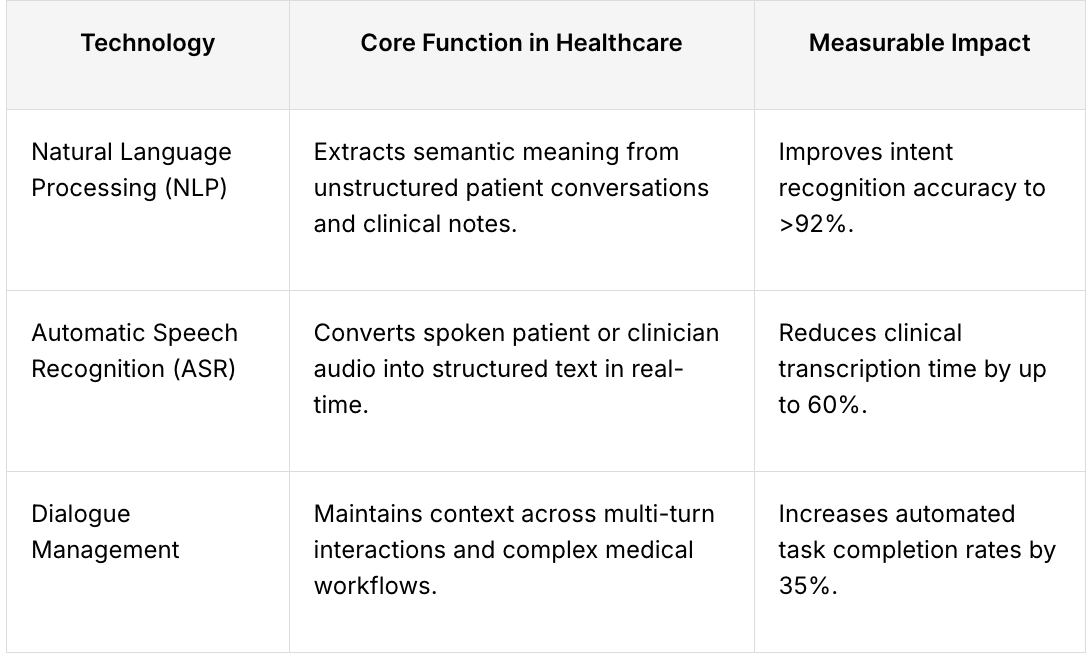
The architecture of healthcare conversational AI relies on three interconnected technological pillars that process, understand, and generate human language. To maintain clinical accuracy and prevent factual errors, modern systems utilize Retrieval-Augmented Generation (RAG). RAG augments models with up-to-date external knowledge for clinical accuracy, grounding responses in validated medical literature rather than relying solely on the model's pre-trained weights.
How conversational AI transforms healthcare delivery
Deploying conversational AI across clinical and administrative environments fundamentally reshapes how healthcare providers manage patient care and operational workflows.
Enhancing patient interaction and support
Modern virtual assistants provide patients with 24/7 access to health information, significantly improving patient engagement and satisfaction. Conversational LLMs excel at answering general health questions and collecting patient information, acting as a highly efficient digital front door for medical practices. By automating the initial intake process, these systems can reduce patient wait times by an average of 15 to 20 minutes per visit. Smart routing capabilities ensure that critical patient conversations are immediately escalated to human healthcare professionals, optimizing the balance between automated support and personalized patient care.
Streamlining administrative and operational tasks
The administrative burden on healthcare staff is a primary driver of burnout, with clinicians often spending up to two hours on paperwork for every hour of patient care. Conversational AI addresses this by generating text to alleviate staff workload, automatically drafting clinical notes, and summarizing patient histories. By integrating with scheduling platforms, these systems can automate appointment booking, cancellations, and rescheduling, which typically reduces administrative overhead by 30%. This automation allows medical staff to redirect thousands of hours annually toward direct clinical workflows and patient-facing activities.
Supporting clinical workflows and decision-making
While artificial intelligence offers robust support for data synthesis, its role in direct clinical decision-making requires strict boundaries. Conversational LLMs remain less reliable for diagnostic decisions and symptom-based recommendations, necessitating human oversight for all diagnostic conclusions. The technology excels at supporting clinicians by surfacing relevant patient history, cross-referencing medication interactions, and structuring unstructured EHR data By acting as intelligent clinical assistants, these tools can reduce chart review times by up to 45%, allowing healthcare providers to make faster, more informed decisions based on comprehensive data insights.
Improving health outcomes through adherence and education
Post-discharge care and chronic disease management rely heavily on consistent patient education and medication adherence. Conversational AI platforms can deploy automated, personalized follow-up sequences that check on patient recovery metrics and send smart medication reminders. Studies indicate that interactive virtual monitoring can boost medication adherence rates by 20% to 30% among chronic care populations. By proactively answering routine questions about side effects or recovery protocols, these systems prevent unnecessary hospital readmissions and foster better long-term health outcomes through continuous, scalable patient engagement.
Key benefits of conversational AI for the healthcare industry
The strategic implementation of conversational AI yields measurable improvements across financial, operational, and clinical metrics for healthcare organizations.
Increased efficiency and cost reduction
Implementing conversational artificial intelligence drives significant financial optimization by automating high-volume, low-complexity tasks. Healthcare organizations typically observe a 25% to 30% reduction in call center operational costs within the first year of deployment. By deflecting routine inquiries regarding billing, clinic hours, and basic appointment scheduling, the technology saves an estimated $15 to $20 per diverted interaction. This increased efficiency allows medical practices to scale their patient support capabilities without a proportional increase in administrative headcount, fundamentally improving the organization's bottom line.
Improved patient experience and access
Conversational AI democratizes access to healthcare services by eliminating traditional barriers such as hold times and restricted clinic hours. Patients benefit from instantaneous responses to their inquiries, leading to a reported 40% increase in overall patient satisfaction scores regarding digital access. Multilingual virtual assistants can communicate with diverse patient populations in their native language, bridging critical communication gaps. This on-demand access ensures that patients feel supported throughout their healthcare journey, from initial symptom checking to post-appointment follow-ups.
Enhanced data collection and insights
Every interaction with a conversational AI platform generates valuable, structured data that can be applied for population health management. These systems capture 100% of patient conversations, transforming unstructured dialogue into actionable insights regarding community health trends, common patient grievances, and service bottlenecks. By analyzing this aggregated data, healthcare providers can proactively adjust staffing levels, refine clinical workflows, and identify gaps in patient education. This continuous feedback loop ensures that practice management decisions are driven by empirical data rather than anecdotal evidence.
Navigating challenges and ethical considerations
Despite its potential, integrating artificial intelligence into healthcare requires strict adherence to ethical standards, data security protocols, and regulatory frameworks.
Data privacy, security, and regulatory compliance
%201.png)
The deployment of conversational AI in medical settings mandates rigorous data protection architectures to safeguard sensitive patient information. Organizations must strictly adhere to the HIPAA Privacy Rule standards codified under 45 CFR Part 160 and Part 164, which govern the secure transmission, storage, and processing of protected health information (PHI). Enterprise-grade systems maintain compliance by implementing end-to-end encryption, role-based access controls, and automated data anonymization protocols. Failure to maintain these security standards can result in severe financial penalties, with HIPAA violation fines reaching up to $1.5 million per incident category annually.
Ensuring accuracy and avoiding bias
The clinical viability of generative AI depends entirely on its factual reliability and neutrality. Currently, 89% of evaluated medical LLM research papers express concerns regarding reliability or bias, highlighting the risks of deploying unchecked models. To mitigate these risks, grounding LLM responses in validated references prevents factual hallucinations during medical inquiries. Developers must actively audit training datasets to eliminate algorithmic bias that could disproportionately impact minority patient populations, ensuring that the AI provides equitable, evidence-based support across all demographic groups.
Integration with existing systems
For conversational AI to deliver true value, it must integrate with existing Electronic Health Records (EHR) and clinical management platforms without losing critical context. This interoperability is often hindered by fragmented legacy systems and proprietary data silos. Successful deployments utilize standardized communication protocols, such as HL7 and FHIR (Fast Healthcare Interoperability Resources), to facilitate real-time, bidirectional data synchronization. Proper integration reduces manual data reconciliation by up to 50%, ensuring that clinicians always have access to the most current patient information during human conversations.
The future landscape of conversational AI in healthcare by 2026
By 2026, the evolution of healthcare AI will shift from basic text generation to highly structured, context-aware systems driven by advanced data architectures.
Advanced personalization and predictive capabilities
The next generation of conversational AI will apply predictive analytics to anticipate patient needs before they explicitly articulate them. By analyzing historical health data, biometric inputs, and social determinants of health, these systems will offer hyper-personalized care recommendations and proactive intervention alerts. However, as these models become more autonomous, 100% of reviewed healthcare prediction studies raised reliability concerns requiring rigorous safeguards. Consequently, future platforms will require transparent confidence scoring mechanisms, ensuring that predictive outputs are always verifiable by human clinicians before impacting patient care pathways.
The role of knowledge graphs and ontologies for trustworthy AI
%201.png)
To overcome the limitations of standard vector-based retrieval, the future of healthcare AI relies on semantic data structuring. Other AI solutions convert data into 0s and 1s, losing meaning in the process. At Lettria, we maintain the structure and relationships in your data, building knowledge graphs that preserve how symptoms, diagnoses, and treatments connect to one another. This deterministic approach eliminates the contextual loss often seen in traditional LLMs.
Our ontology toolkit structures complex medical information for trustworthy AI in regulated industries, ensuring relationships are explicitly defined and preserved. Perseus intelligent RAG and knowledge graph retrieval capabilities for enterprise healthcare deployments allow organizations to convert unstructured clinical documents into queryable graph databases. This GraphRAG methodology delivers up to 30% more accurate results, providing the traceability and precision required for regulated medical environments.
Conclusion: revolutionizing healthcare delivery
Conversational AI is fundamentally transforming the healthcare sector by bridging the gap between administrative efficiency and high-quality patient care. By automating routine tasks, improving data accessibility, and providing 24/7 patient support, these technologies allow clinicians to focus on complex medical decision-making. However, realizing this potential requires deploying systems that prioritize accuracy, privacy, and semantic understanding.
The real challenge isn't building another chatbot. It's building AI that understands your clinical data, preserves context across every patient interaction, and delivers answers you can trace back to verified sources. That's what separates useful automation from trustworthy healthcare intelligence.
We encourage readers to book a demo with Lettria to deploy secure, ontology-driven healthcare AI that transforms unstructured medical data into actionable, verifiable insights.
Frequently asked questions
What is the difference between a chatbot and conversational AI in healthcare?
Traditional chatbots rely on rigid, pre-programmed rules and decision trees to answer basic queries. Conversational AI utilizes advanced natural language processing and machine learning to understand context, manage complex multi-turn patient conversations, and dynamically generate personalized responses.
How does conversational AI ensure patient data privacy?
Enterprise conversational AI systems utilize end-to-end encryption, data anonymization, and secure cloud infrastructure to protect sensitive data. Specifically, HIPAA requires safeguards and restricts unauthorized disclosure of protected health information, mandating strict access controls and audit trails for all AI interactions.
What are the main challenges of implementing conversational AI in healthcare?
Successful implementation requires addressing complex technical and ethical hurdles. Key healthcare LLM challenges include reliability, algorithmic bias, data privacy, and public acceptability, necessitating rigorous testing, EHR integration, and continuous monitoring to maintain equitable and accurate patient care.
Can conversational AI replace human healthcare professionals?
No, conversational AI is designed to augment, not replace, medical staff by automating administrative tasks and preliminary data collection. It is critical to implement keep-experts-in-the-loop frameworks to maintain medical accuracy and patient safety, ensuring human clinicians always make final diagnostic decisions.
Frequently Asked Questions
Yes. Lettria’s platform including Perseus is API-first, so we support over 50 native connectors and workflow automation tools (like Power Automate, web hooks etc,). We provide the speedy embedding of document intelligence into current compliance, audit, and risk management systems without disrupting existing processes or requiring extensive IT overhaul.
It dramatically reduces time spent on manual document parsing and risk identification by automating ontology building and semantic reasoning across large document sets. It can process an entire RFP answer in a few seconds, highlighting all compliant and non-compliant sections against one or multiple regulations, guidelines, or policies. This helps you quickly identify risks and ensure full compliance without manual review delays.
Lettria focuses on document intelligence for compliance, one of the hardest and most complex untapped challenges in the field. To tackle this, Lettria uses a unique graph-based text-to-graph generation model that is 30% more accurate and runs 400x faster than popular LLMs for parsing complex, multimodal compliance documents. It preserves document layout features like tables and diagrams as well as semantic relationships, enabling precise extraction and understanding of compliance content.


.png)
.png)